KRITIS
Software, use cases & solutions
4.7/5 on Capterra | 2,000+ satisfied customers
What is KRITIS?
Introduction
Critical infrastructures (KRITIS) are organizations and facilities whose services are indispensable for public life and the economy, for example in the areas of energy, water, health, transport or IT.
KRITIS obliges operators to identify risks, implement suitable security measures and demonstrate their effectiveness in order to ensure the availability and functionality of critical infrastructures.
KRITIS creates a framework for:
- the structured handling of risks
- clearly defined responsibilities
- technical and organizational protective measures
- emergency management and security incidents
- Comprehensible evidence for the authorities

Use cases
Use cases relating to ISMS, risk and compliance management

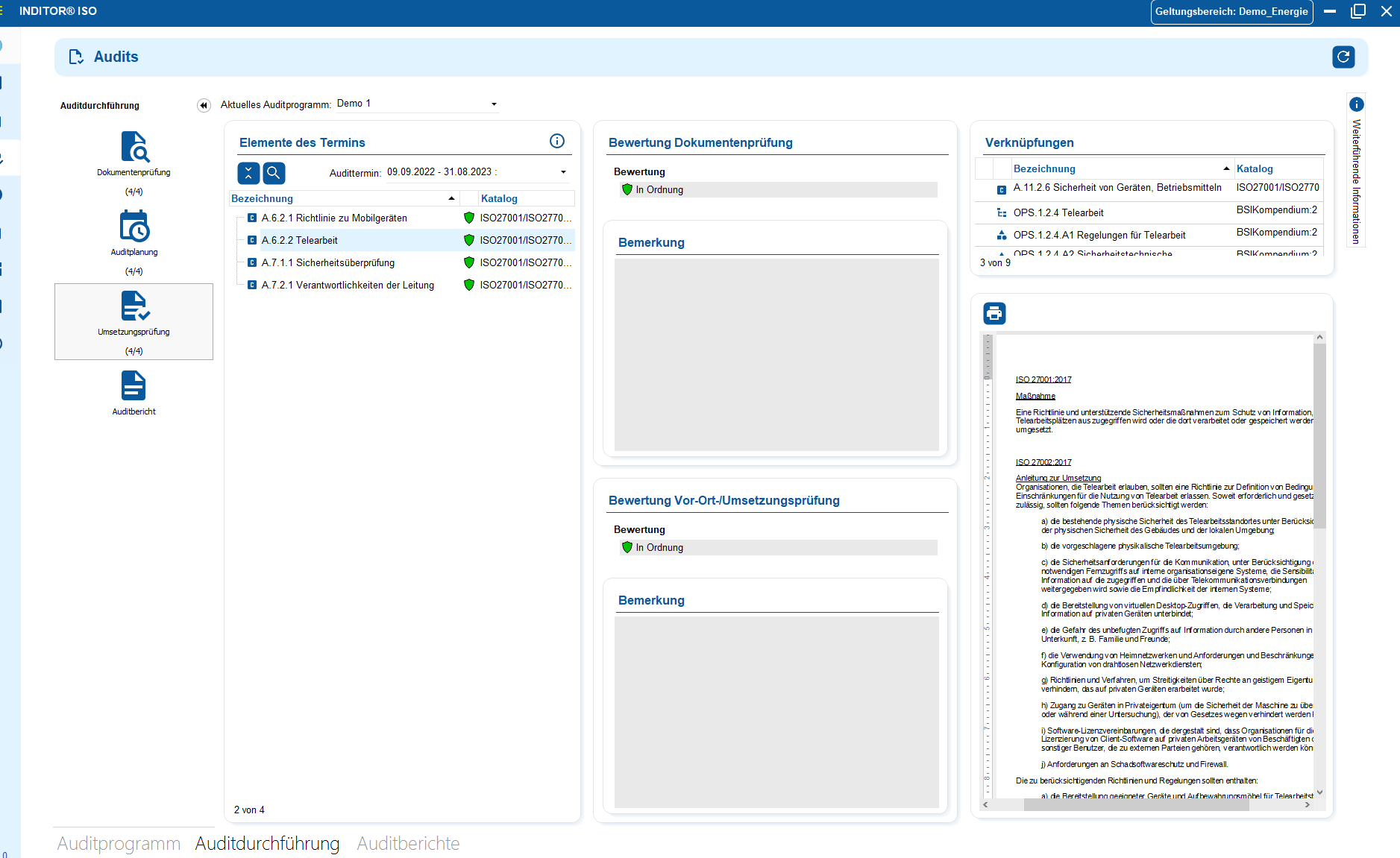
You control audits centrally, plan audits, document results and automatically generate audit reports.

You can manage documents in an audit-proof manner, version and edit them directly in the tool and use templates and import functions.

i-doit supports GAP analyses according to standards such as ISO 27001, ISO 9001 or NIS2, including maturity level assessment, responsibilities and document assignment.

You evaluate and manage suppliers centrally, document contracts and maintain contact details and replacement suppliers.

You derive measures, distribute tasks, track deadlines and receive automatic notifications by e-mail.

You document and evaluate security incidents in accordance with ISO and NIS2, assign affected assets and centrally derive measures.
Why ISMS?
Why an information security
management system forms the basis
Operators of critical infrastructures often face the same problem: there is no central information base for security-related issues. Responsibilities are distributed, risks are considered selectively and measures are stored in folders, tables or departments.
However, KRITIS does not require a collection of individual measures, but a functioning management system that controls risks, processes, responsibilities and evidence in a comprehensible manner.
Without an ISMS, there are gaps that become apparent during an audit at the latest: missing dependencies, unclear roles, no proof of effectiveness.
Advantages:
- Clear entry: Structured model for risks, measures, protection requirements, responsibilities and documents - without scattered Excel lists or heterogeneous filing systems.
- Complete traceability: Every decision, test, effectiveness assessment and change is versioned and historicized - a key point for KRITIS audits.
- Process support according to KRITIS: Risk analysis, risk treatment, emergency and restart planning, service provider management, incident management and continuous improvement are integrated and systematically controllable.
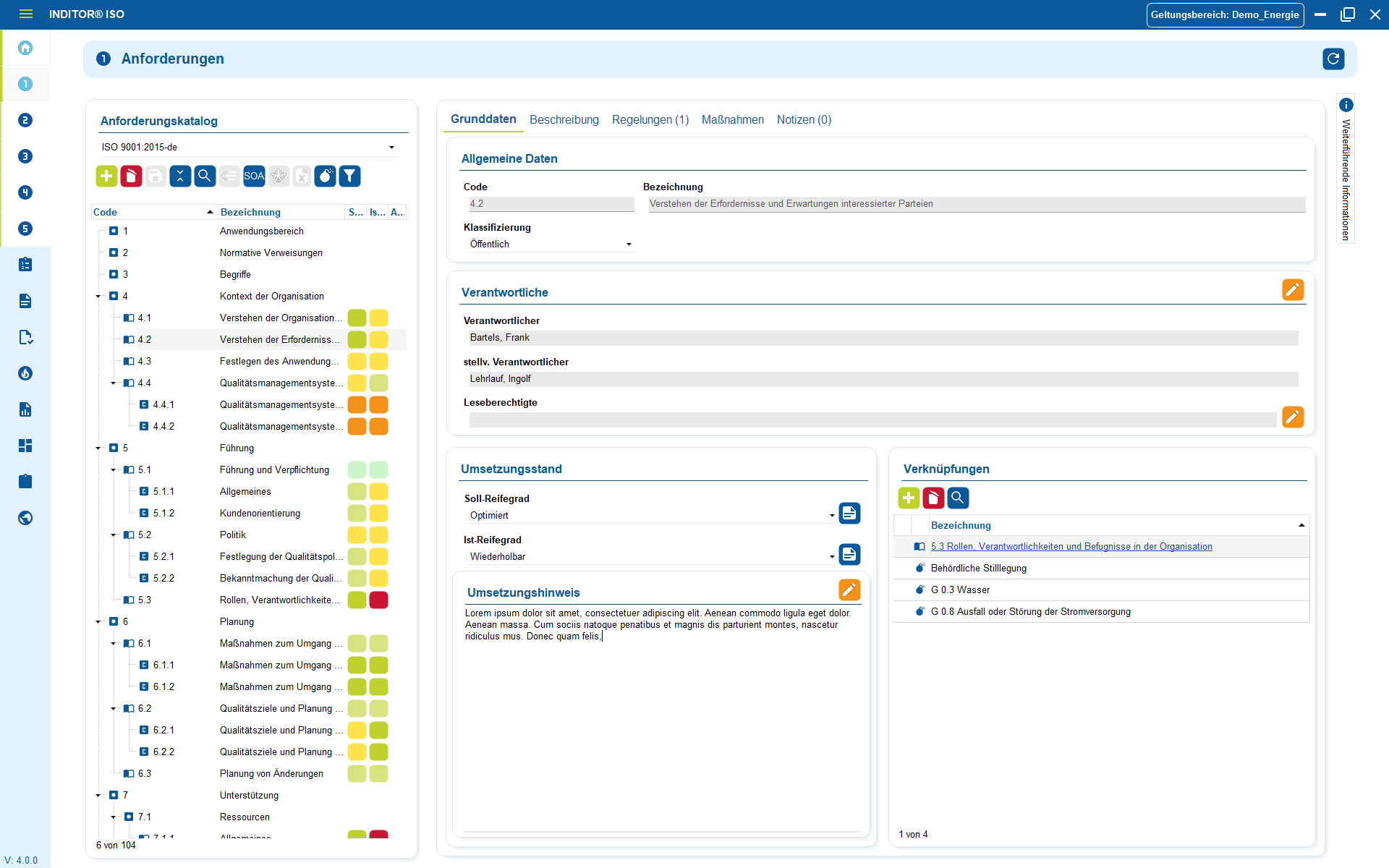
Each requirement of the standard is managed as a separate data record - with responsible persons, maturity level, implementation instructions and links.
3 steps to an ISMS
How you can achieve your ISMS in 3 steps
functions and risks
and verify
manage
1. Recognize critical functions and risks
Asset management is a key component for CRITIS operators:
It must be possible to understand which systems, facilities and processes are in use, what role they play in the operation of critical services, how high their protection requirements are and what risks arise from them.
Structured asset recording fully maps these requirements:
All relevant information assets - from technical components and network segments to applications, locations and operating processes through to external service providers and responsibilities - are centrally recorded, logically linked and assessed according to their criticality.
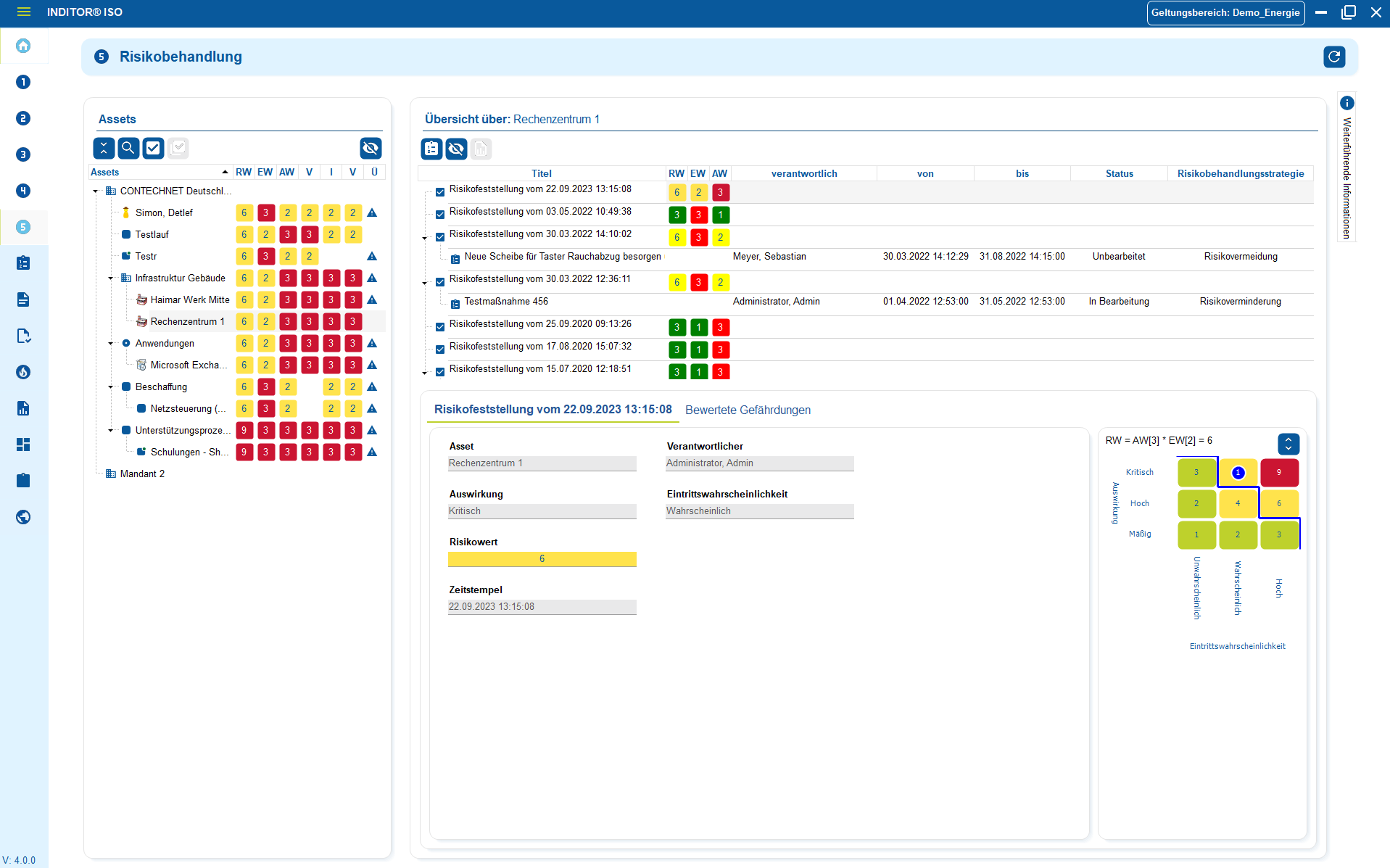
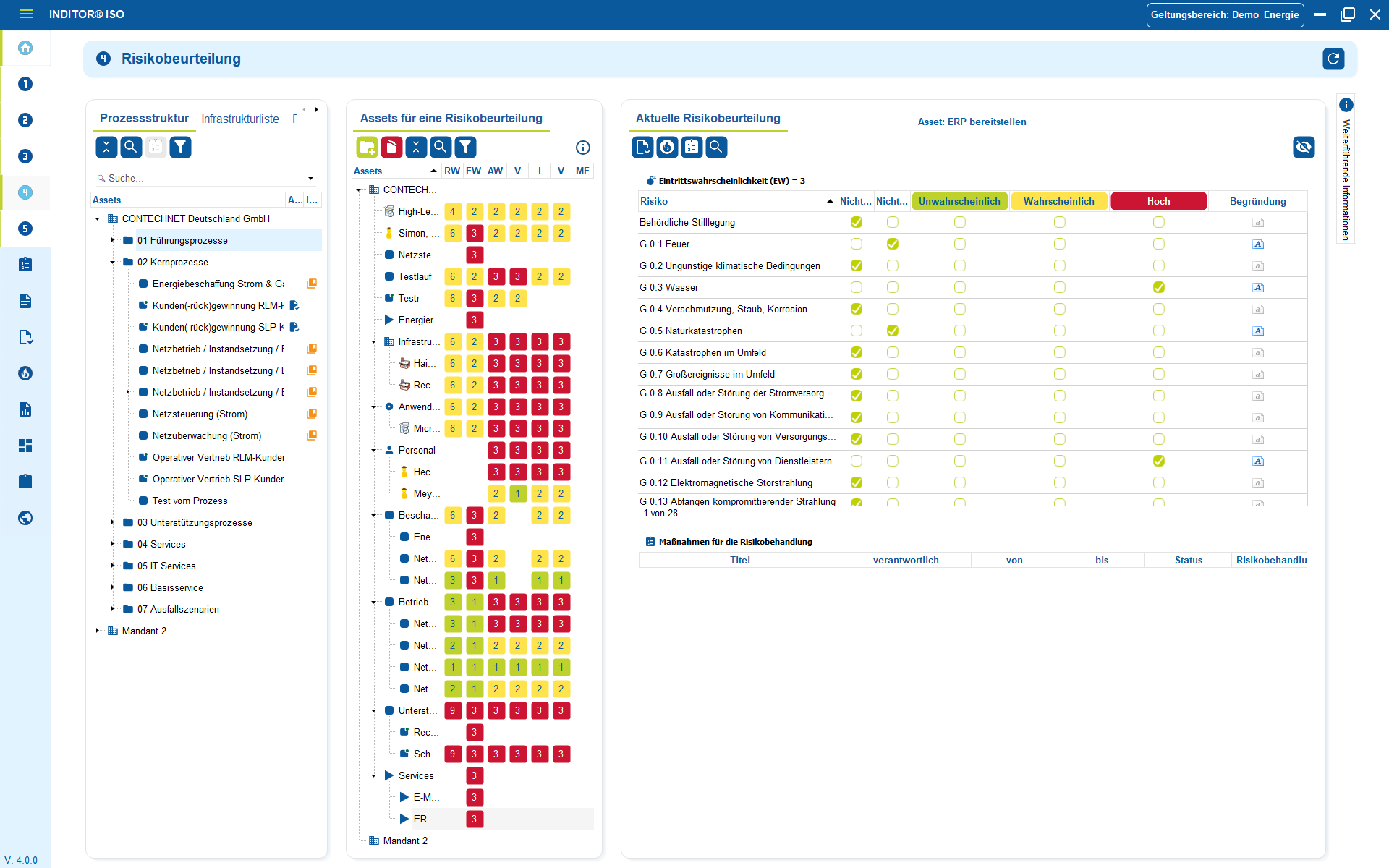
On this basis, the risk analysis cannot be carried out in the abstract, but in the real system and process context .
Threats, vulnerabilities and effects are assigned directly to the respective objects, so that the assessment is not based on tables or gut feeling, but on the actual operational dependency.
Advantages:
- KRITIS-compliant asset management: All relevant system components, business and operating processes and responsibilities are recorded in a complete, structured and auditable manner.
- Risk analysis on the object: Threats, vulnerabilities and effects can be assessed directly on assets, process chains or critical functions - instead of in isolated lists.
- Assignable measures: Technical and organizational security measures can be assigned directly to the affected assets, risks or processes.
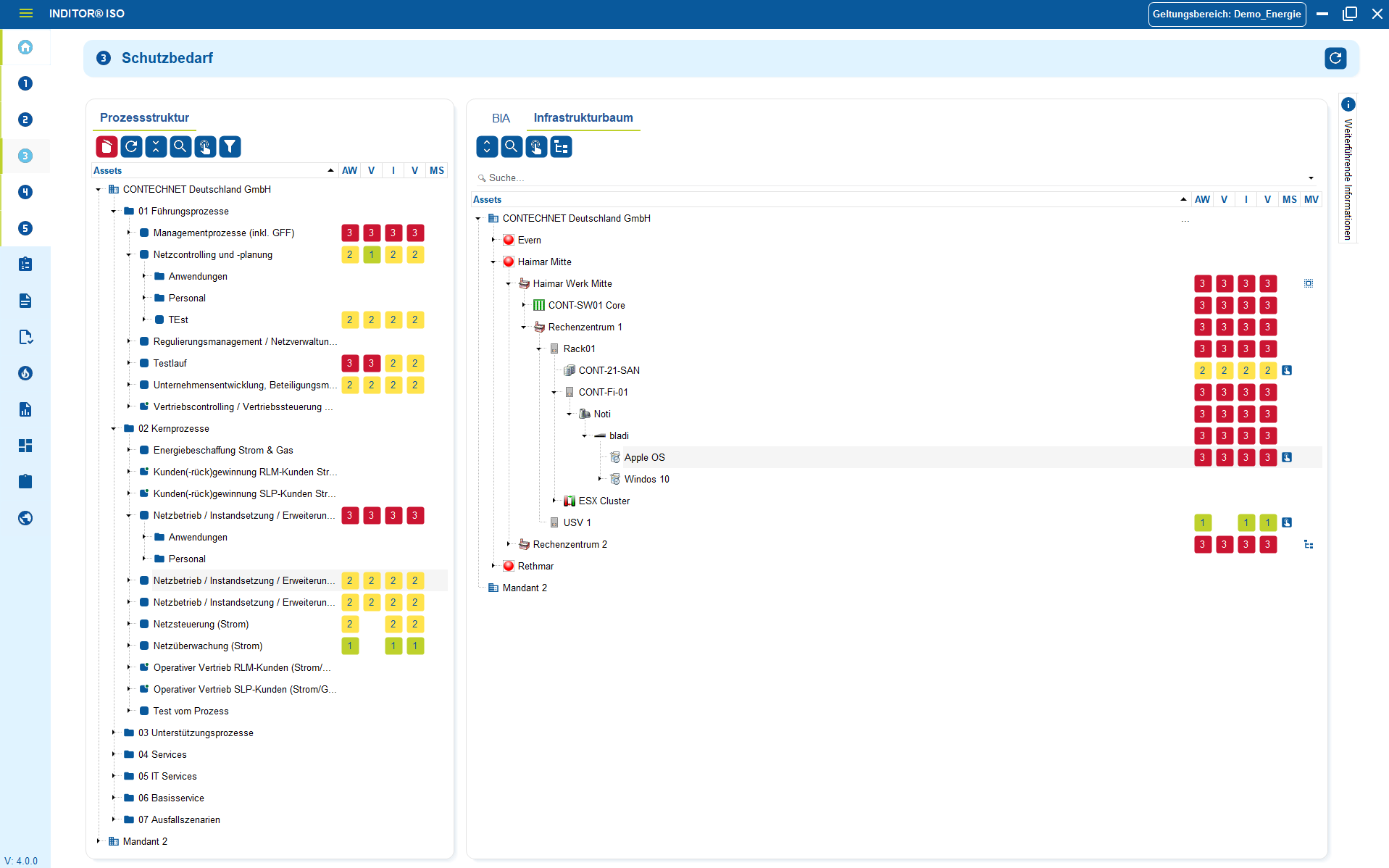
- Integrated determination of protection requirements: Criticality and impact on availability, integrity and confidentiality are assessed centrally and are automatically incorporated into risk and measure decisions.
Requirements can be defined for different assets and asset groups.

2. Plan, implement and demonstrate measures
For KRITIS operators, identified risks and vulnerabilities must be addressed through appropriate technical and organizational measures.
These measures must be implemented effectively, comprehensibly and in line with real systems, operating processes and dependencies - not as theoretical specifications.
This is exactly what a structured measures management system makes possible:
Measures are recorded centrally, assigned to the relevant risks, systems or processes and documented in an audit-proof manner.
This makes it possible to see at any time which measures have been implemented, checked, adapted or are still open - and what impact they have on the operational safety of critical services.
Advantages:
- KRITIS-compliant measure management: Technical and organizational measures are systematically recorded, prioritized and implemented - instead of being scattered in lists or individual projects.
- Audit-proof documentation: Every change, evaluation and effectiveness check is historicized - reliable for internal controls and external audits.
- Responsibilities & deadlines integrated: Each measure is assigned responsible parties, due dates and status; delays can be escalated and verifiably addressed.
- Proof of effectiveness: Measures are not only defined, but also regularly checked for effectiveness - including adjustments and lessons learned.
- Direct link to assets & risks: Measures are attached to real systems, processes or service provider chains - not abstract or isolated.
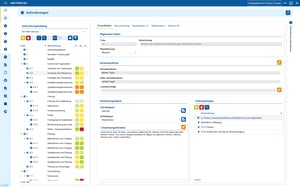
Implementation status of your ISO 27001 catalog of measures including verification requirements

3. Manage policies and procedures in an audit-proof manner
For KRITIS operators, structured, traceable and version-controlled documentation of all security-relevant content is absolutely essential - from guidelines and operating procedures to emergency and restart concepts through to tests, measures and proof of effectiveness.
This documentation must be clearly assigned, up-to-date and effective in the context of the actual systems, processes and risks.
A central documentation management system fulfills precisely these requirements:
Guidelines, processes, work instructions, incident logs and audit reports are managed in a standardized manner, versioned and directly linked to assets, risks, measures and responsibilities.
The result is a consistent and auditable documentation basis that stands up to KRITIS audits - without scattered folders, islands of knowledge or gaps in interpretation.
Advantages:
- Central storage of all security-relevant documents: guidelines, operating and emergency procedures, work instructions, protocols and test reports in one place.
- Versioning & historization: Changes are documented in an audit-proof manner - including the person responsible, time stamps and reason for change.
- Evidence management for KRITIS audits: Decisions, measures, incidents and effectiveness assessments are fully traceable and auditable.
- Link to assets, risks & measures: Documents are not isolated, but in the direct context of the real infrastructure, processes and responsibilities.
Implementation status of your ISO 27001 catalog of measures including verification obligations

Industries
View all solutions for your industry


Read more


Example use cases
Take a look at further use cases
assets
and system manuals
management
management
and access
1. Import of existing assets
Many companies already have data on systems, applications, locations, contracts or responsibilities. However, it is often scattered across Excel lists, internal repositories, monitoring information or previous inventories. Instead of manually entering this information again, existing structures can be adopted and integrated into a central information security architecture.
The import enables an orderly consolidation of all relevant assets - from technical components, cloud services and process data to roles and responsibilities. During the import process, the data is classified, responsibilities are assigned and dependencies are made visible.
On this basis, protection requirements can be determined, risks assessed and suitable measures assigned in accordance with ISO 27001.
Advantages:
- No starting from scratch: existing information is transferred instead of newly recorded
- Transparency: assets, responsibilities and dependencies are clearly visible
- Structure: classification, protection requirements and risks can be assigned directly
- Traceability: changes are versioned and documented for auditing purposes
- Future-proof: repeatable imports avoid data silos and duplicate maintenance
Image shows: Import your existing assets from Excel or other third-party tools

2. IT concepts, emergency and system manuals
Create, link and maintain operational and emergency documentation in a structured and audit-proof manner.
With our tools, you can create and maintain all important technical documentation in a complete, up-to-date and audit-proof manner. Data changes are automatically transferred to emergency and system manuals, operating concepts and guidelines. These can be linked directly to the associated assets, processes and locations. This means that all documentation is automatically fed with real statuses from the IT landscape and remains permanently consistent.
All relevant information such as responsibilities, operating parameters, dependencies, restart processes and recovery times (RTO/RPO) are maintained and versioned centrally. The connection to infrastructure, applications and services means that documentation is not only maintained, but actively lived and constantly kept up to date. This is one of the most important factors for audits, certifications and operational stability.
Advantages:
- Centralized, versioned and audit-proof documentation
- Clear responsibilities and traceable operating processes
- Audit and audit-proof evidence in accordance with ISO 27001, NIS2 and BSI requirements
- Faster restart times in an emergency thanks to clear, always up-to-date instructions
- Transparent dependencies between systems, processes and services
Picture shows: System and emergency manuals can be generated from the available information. These can be regularly updated and stored in a georedundant manner .

3. Security incident management
Link processes and associated assets
Control IT service processes efficiently and transparently. With the integration of ticket systems in i-doit, you can bundle all processes in one place. From fault reports and change requests to service requests. The link to your assets, contracts and responsibilities creates a central information base for the entire IT operation.
Tickets are documented in a traceable manner, automatically classified and can be prioritized, delegated and closed using defined workflows. This creates a smooth process between technology, organization and support.
Advantages:
- Standardized control of all IT processes
- Clear responsibilities and faster response times
- Seamless traceability of changes and measures
- Direct connection to CMDB objects and documentation
- Basis for key figures, evaluations and process optimization
Image shows: Security incidents can be recorded centrally and included in the risk assessment

4. Supplier management
External service providers, hosting providers, maintenance partners or cloud services are often directly involved in critical business processes. Structured supplier management makes it possible to map their services, risks, contracts and dependencies centrally. Responsibilities, service levels, security requirements and effects on information assets are documented in a traceable manner and linked to the relevant processes and measures.
This allows companies to retain control over which suppliers have access to which information assets, which requirements apply and whether agreed protective measures are being adhered to
Advantages:
- Transparency across all security-relevant suppliers and service providers
- Traceable assignment to assets, processes, locations and risks
- Clear responsibilities, competencies and service levels
- Contractual security requirements and compliance specifications can be documented centrally
- Ready to provide evidence for audits, certifications and regulatory checks
Picture shows: The status of systems, devices and other assets is directly visible in the IT documentation.

5. Control & distribution of tasks and access
A functioning ISMS requires clear responsibilities. Who evaluates measures, who releases risks, who is allowed to change guidelines or who is only allowed to read - all of this determines security, efficiency and auditability.
Finely granulated role and authorization concepts clearly assign responsibilities: Teams, departments and individuals are given exactly the access they need for their tasks. Sensitive information remains protected, operational processes remain transparent and evidence is not diluted.
Advantages:
- Clear responsibilities: Roles and tasks are clearly assigned - no gray areas or duplication of responsibilities.
- Finely granulated access control: Authorizations for objects, categories and processes can be precisely defined.
- Protection of sensitive information: Critical data is only visible and editable for authorized users.
- Auditability through traceability: every action can be traced back in terms of time, organization and personnel.
- Reduced errors and misunderstandings: Teams only work with the information they really need.
Image shows: Audit check with direct links to standard requirements, measures and evidence - fully traceable and auditable.

Book your personal live demo
Our i-doit team will be happy to take the time to advise you personally on your application.