
i-doit
CMDB, ITSM, ITIL, IT-Docu







Use the i-doit AI add-ons to increase your level of automation with the help of AI!



Table of Contents
1. ITIL 4: Processes, framework and application in practice
2. From process model to framework: Facts about the history of ITIL
3. Structure of the ITIL 4 framework
4. ITIL certifications: Levels and content
5. Why ITIL 4 is more important today than ever before
6. What is the difference between ITIL and ITSM?
7. Collaboration between ITIL V4 and other frameworks
8. Implementation and introduction of ITIL in companies
9. Examples of ITIL practices
10: How can i-doit support you in the long term with ITIL implementation?
11: ITIL offers modern structures for flexible IT service management
What does ITIL actually stand for? It is the abbreviation for "Information Technology Infrastructure Library". ITIL is a framework for processes, roles, tools and procedures that provide and manage IT services. In this way, ITIL provides a solid framework for IT Service Management (ITSM). The current version, ITIL 4, supports you in making IT services even more efficient. In this way, you shorten response times and react quickly to fundamental changes. With an ITIL certification, you prove that you understand the ITIL best practices and can apply them in practice.
Learn about the basics of ITIL and the current version now. In the process, you will receive practical tips for successfully using ITIL as a framework in your company.
With the first version, the British Central Computer and Telecommunications Agency (CCTA) laid the foundation for ITIL in the 1980s. With this, the CCTA wanted to create binding standards for the IT sector. Compared to ITIL 4, the focus of the second version (1999-2004) was on process thinking in the areas of Incident Management, Problem Management and Change Management. ITIL V3 introduced the Service Lifecycle in 2007.
ITIL 2011 was developed on the basis of V3. Eight years later, ITIL 4 followed: to this day, it focuses on greater flexibility and modularity as well as the integration of modern methods in ITSM. Its Service Value System (SVS) replaces the lifecycle approach. ITIL 4 also takes into account topics such as Lean IT, Agile and DevOps.
Here you can see an overview of the certifications prior to ITIL 4:
With ITIL 4, the focus is not only on the actual process. It also depends on the interaction of all value-creating elements. It is noticeable that ITIL 4 no longer uses the term "Processes". Instead, it speaks of "Practices". A process represents a component of a practice.
In contrast to ITIL 3, ITIL 4 does not rely on a rigid lifecycle approach, but on the flexible Service Value System (SVS). This model adapts to different ways of working and is therefore suitable for classic, agile and hybrid environments. The actual added value for the company is placed at the centre.
In order for ITIL 4 to work in practice, a clear overview of the IT is essential. This is exactly where IT documentation with i-doit provides support: it shows which systems exist and how they are interconnected. This creates the basis for central processes such as incident management, change management or service monitoring – entirely in the spirit of ITIL 4.
Certification according to the ITIL standard is carried out via accredited providers. The structure is modular:
ITIL 4 Foundation: This covers basic knowledge of ITIL 4, the Service Value System, central terms as well as practices.
ITIL 4 Managing Professional: This certification is aimed at ITSM practitioners who wish to gain comprehensive know-how. It covers topics such as service creation, delivery, support and stakeholder management.
ITIL 4 Strategic Leader: Focus on strategy development, corporate goals and their support through IT services.
ITIL is a future-oriented framework inIT Service Management (ITSM). Why? It continuously adapts to new challenges such as automation and cloud services.
Through the integration of agile DevOps and Lean methods, ITIL 4 remains highly relevant for ITSM. Specifically, this means:
The difference between ITSM and ITIL can be explained simply: ITSM is the concept for the holistic management of IT services. ITIL, on the other hand, is the most widely used framework for implementing ITSM.
Or to put it another way: ITSM describes what is done. And ITIL shows how the implementation takes place. Numerous companies use supplementary tools such as a Configuration Management Database (CMDB) for IT documentation in order to operationalise ITIL-compliant processes such as configuration management.
ITIL 4 is designed so that it can be used seamlessly alongside other working methods or IT frameworks. In doing so, their principles are subject to no restrictions.
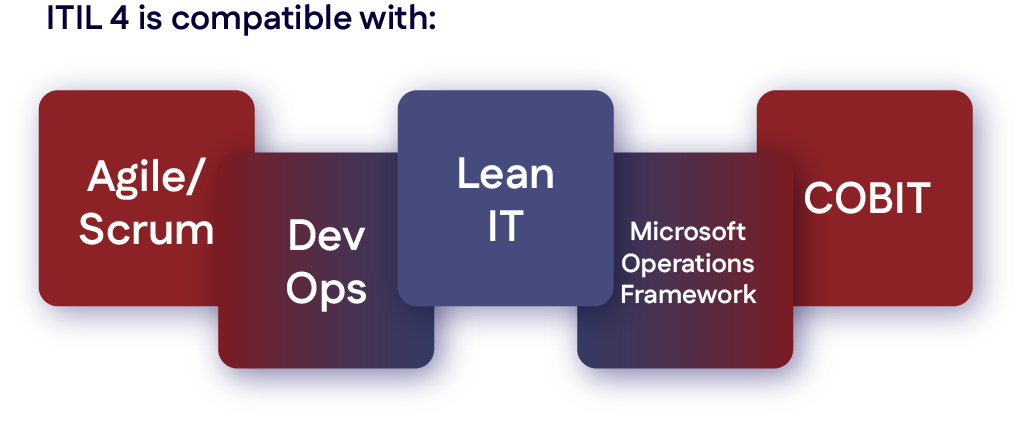 The implementation of ITIL does not hinder other methods. On the contrary, it even promotes their structured integration into service management.
Do not see ITIL simply as an "IT project". Rather, you are dealing with a company-wide approach for better service management. The successful implementation of ITIL requires these steps:
The following practices are part of the ITIL 4 Service Value System. They help to make the provision of IT services measurable and traceable:
With i-doit, you can manage all your assets centrally. All changes to devices, processes and services are automatically documented. Each asset can be mapped with precision in accordance with the defined configuration management. By grouping processes and (IT) services, dependencies and relationships can be visually represented as well as regularly audited and assessed.
Thanks to numerous interfaces, it is also possible to connect a (Single Point of Contact) service desk and link it directly to the assets. In this way, incidents, approvals, changes, releases and long-term problem solutions can be recorded, controlled and documented sustainably.
This makes i-doit not just an asset management tool, but the company-wide, central platform for IT documentation and ITIL processes.
The structures of ITIL 4 support your IT in working efficiently and in a customer-orientated manner. ITIL certification is proof of methodical knowledge in IT service management. Thanks to the modular structure of the ITIL 4 framework, you can start exactly where there is a need for optimisation. This applies particularly to change and service levels or configuration management.
Would you like to introduce ITIL 4 in your company or support existing ITIL practices with a high-performance CMDB? Find out more about i-doit: the IT documentation tool that perfectly fits your IT infrastructure.
.png?width=300&name=experienced-data-center-it-technician-installing-resized%20(1).png)